
Views: 0 Author: Site Editor Publish Time: 2026-09-03 Origin: Site


Struggling to beat the summer heat efficiently without driving up your monthly energy bill? Bulky pedestal fans often waste valuable floor space and disrupt the aesthetic of modern living rooms. A cooling tower fan offers a sleek, sophisticated alternative. In this comprehensive guide, we will break down exactly how these appliances operate from an engineering perspective. We will explore their unique internal mechanics, clarify how they differ from traditional cooling devices, and provide actionable tips on selecting the perfect model for your home today.
Recent industry analyses reveal a definitive shift in the domestic cooling market. Driven by increasingly stringent global energy efficiency standards, consumer demand is pivoting away from traditional axial blade designs. Instead, the market is embracing centrifugal airflow systems. This technological evolution not only slashes domestic power consumption but also caters to the modern need for ultra-quiet, unobtrusive appliances that blend seamlessly into interior spaces.
Unique Airflow Mechanism: Unlike traditional devices with horizontal propeller blades, a cooling tower fan utilizes a vertical cylindrical impeller. This mechanism draws air in and propels it outward, generating a broader and more consistent breeze across the room.
Space and Safety: Engineered with a tall, slender profile, these units conserve significant floor space. The internal blades are completely enclosed by narrow grilles, making them structurally safer for households with active children and pets.
Energy Efficiency: Modern units are designed for optimal power consumption. A standard 50W motor delivers substantial air circulation while drawing a fraction of the electricity required by a conventional air conditioning system.
Enhanced Convenience: Today’s consumer models integrate advanced smart features. Users can effortlessly modify speed settings, toggle oscillation, and program sleep timers from a distance, maximizing everyday convenience.
Before specifying a cooling unit for a space, it helps to understand the underlying fluid dynamics. While they serve the same fundamental purpose as standard fans—moving ambient air—their internal mechanics are entirely different.
Traditional fans rely on axial airflow, where angled blades physically chop the air and push it forward. In contrast, a cooling tower fan utilizes a vertical cylindrical impeller. In engineering terms, this is frequently referred to as a blower wheel or a squirrel cage fan.
This elongated cylinder is lined with vertical, slightly curved blades. As the cylinder rotates, it creates a localized pressure differential. The vertical orientation allows the impeller to capture a larger volume of air along the entire height of the unit, rather than just from a centralized circular point. Consequently, this specific design produces a tall, continuous wall of airflow rather than a concentrated, choppy stream.
The airflow process in this system relies heavily on centrifugal force. When the internal blower wheel spins, air is drawn into the unit through intake vents. These are usually located at the back or along the sides of the outer casing.
Once inside, the air enters the spinning cylindrical impeller. The curved blades catch the incoming air, accelerate it, and push it toward the front of the unit using centrifugal energy. The air is then forced through a specialized vertical exhaust vent or louver system. These louvers act as a guide. They smooth out the turbulence and direct the accelerated air into your living space in a uniform, vertical column.
The driving force behind the impeller is an electric motor, typically housed at the heavy base of the unit to maintain a low center of gravity. These motors are engineered to provide consistent rotational torque while maintaining exceptionally low energy consumption.
A well-engineered motor strikes an optimal balance. It provides enough rotational speed to generate a powerful breeze without causing a noticeable spike in household electrical bills. In practice, the efficiency of tower fan motors is directly tied to the aerodynamic design of the blower wheel. Because the wheel distributes air so evenly, the motor does not have to work nearly as hard as it would to spin heavy, horizontal propeller blades.
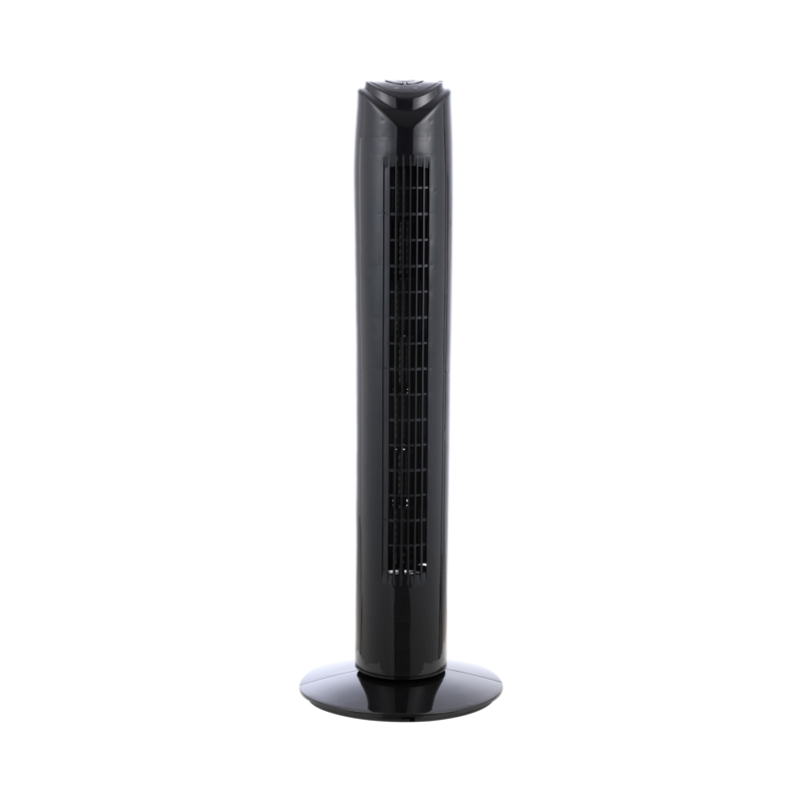
Beyond the basic mechanics of moving air, manufacturers incorporate specific features designed to enhance spatial comfort and the overall user experience. Moving from basic functionality to premium comfort requires a closer look at these mechanical additions.
To cool an entire room effectively, localized airflow is often insufficient. This is where oscillation mechanisms become critical. In a high-quality oscillating tower fan, a secondary internal synchronous motor is employed to pivot the unit.
Depending on the specific design, either the entire internal cylinder assembly or the outer casing rotates on a fixed base. This sweeping motion typically covers a radius of 90 to 120 degrees. By distributing the vertical column of air across a wide arc, the device actively breaks up stagnant air pockets. Furthermore, it eliminates thermal hot spots within the room, ensuring that multiple occupants experience the cooling effect simultaneously.
User interface and accessibility are primary drivers of modern purchasing decisions. Operating a fan manually can be highly disruptive, particularly when you are deeply focused on work or trying to fall asleep.
Investing in a 32-inch remote control cooling tower fan utilizes an integrated printed circuit board and an infrared or radio frequency receiver. This allows users to seamlessly interact with the device's micro-controller from across the room. Picture yourself reading in bed; instead of getting up to change the settings, a simple click allows you to adjust variable speeds, engage the oscillation, or activate a sleep mode instantly.
While not a direct replacement for dedicated HEPA air purifiers, many premium models feature rudimentary air quality enhancements. These units often include a washable mesh dust filter at the rear intake vents to capture large particulate matter, such as pet hair and heavy dust. Additionally, some models feature built-in negative ion generators. These ionizers release negatively charged ions into the airflow, causing airborne particles to fall to the floor and marginally improving the perceived freshness of your room.
The term "cooling tower fan" can occasionally cause confusion due to its overlap with heavy industrial vocabulary. To clarify search intent and ensure you are looking at the right equipment, it is essential to distinguish between the two distinct applications.
Residential tower fans are the sleek, portable consumer appliances discussed in this guide. They are designed strictly for indoor, personal comfort. Their primary objective is to move ambient room air to create a wind-chill effect on human skin. They are optimized for quiet acoustics, low power consumption, and aesthetic integration into living rooms and bedrooms.
In the context of industrial engineering, a "cooling tower fan" refers to massive, heavy-duty fans installed at the top of commercial cooling towers. These are often seen at power plants, chemical refineries, or large commercial HVAC systems. These industrial fans are designed to exhaust massive volumes of heat from water through the process of evaporation. While the basic physics of fluid dynamics apply to both, the scale, purpose, and mechanical execution are entirely unrelated.
When evaluating cooling options, consumers often weigh tower fans against traditional pedestal or box fans. The unique architecture of the tower fan provides several objective advantages that cater to modern living.
Feature | Cooling Tower Fan | Traditional Pedestal Fan |
|---|---|---|
Airflow Mechanism | Centrifugal blower wheel (smooth, vertical breeze) | Axial blades (choppy, concentrated stream) |
Floor Space | Minimal footprint; fits in tight corners | Bulky tripod base; requires open space |
Noise Level | Ultra-quiet; aerodynamic design reduces turbulence | Louder buffeting sound from blade chopping |
Safety | Fully enclosed impeller with micro-grilles | Wide wire cages; potential hazard for small fingers |
Traditional pedestal fans feature wide, circular blade cages and bulky, tripod-style bases that consume significant floor space. In contrast, a tower fan boasts a minimal, vertical footprint. This slender design allows the unit to be tucked unobtrusively into tight corners, between pieces of furniture, or alongside desks. Visually, the modern, column-like aesthetic blends much more seamlessly with contemporary interior decor.
Acoustic disruption is a major concern for appliances used in bedrooms and home offices. Traditional axial fans generate noise through the physical chopping of air by the propeller blades, which often results in a buffeting, helicopter-like sound.
Because a tower fan utilizes a centrifugal blower wheel, the air is guided smoothly along the curved vertical blades. This aerodynamic efficiency significantly reduces air turbulence. When placed in a home office, the smooth hum fades into the background, allowing you to take conference calls without distracting background noise. They generally register lower on the decibel scale, providing powerful airflow without disrupting your concentration.
Safety is a paramount metric for households with toddlers or pets. Traditional fans have wide gaps in their wire cages, posing a risk of injury if small fingers or paws reach the fast-moving blades.
Cooling tower fans eliminate this hazard entirely. The internal impeller is housed deep within the casing, and the exterior exhaust vents are designed with micro-grilles. These grilles are specifically engineered to be narrow enough to prevent accidental contact with any moving mechanical parts, providing ultimate peace of mind.
One of the most persistent myths I encounter in the field is that fans lower the physical temperature of a room. To set realistic expectations, it is important to understand the thermodynamics of how these devices actually operate.
A cooling tower fan does not contain a compressor or a refrigerant cycle; therefore, it cannot lower the ambient air temperature of an enclosed space. Instead, it cools people.
When the fan accelerates ambient air and directs it toward a person, the moving air disrupts the thin layer of stagnant, warm air that naturally surrounds the human body. More importantly, the continuous breeze accelerates the evaporation of moisture from the skin. Because evaporation absorbs heat, this rapid process draws body heat away from the skin, creating a physiological sensation of cold known as the wind-chill effect.
To maximize the efficacy of your appliance, strategic placement is required. Placing the fan near an open window during the evening can help draw cooler outdoor air into a stuffy room. Alternatively, positioning the unit near an existing AC vent allows it to capture the artificially cooled air and distribute it much faster and wider across the room. If a room is excessively hot, facing the fan out of an open door can help push the stagnant, warm air out of the space.
For consumers ready to make a purchase, evaluating technical specifications ensures a high return on investment. Here are the objective criteria to analyze when comparing different models on the market to ensure you get exactly what your space requires.
Airflow is often measured in Cubic Feet per Minute (CFM), though many consumer brands simply list wattage and speed tiers. Look for a unit that offers at least three distinct speed settings to accommodate different thermal needs.
Energy efficiency is equally crucial. For a standard bedroom or home office, a 29-inch 50W electric tower fan with 90-degree oscillation is highly recommended. It provides robust rotational torque for mid-sized living spaces without causing a spike in electricity usage. Compared to a window AC unit that might draw up to 1500W, a highly efficient fan costs only pennies a day to operate continuously.
If the device is intended for a bedroom or study, acoustic performance is critical. Always check the manufacturer's decibel (dB) rating. An output of 30 to 40 dB is ideal for sleeping, equivalent to a quiet library. Ratings between 40 and 50 dB are suitable for living rooms. Seek models that specifically advertise a "Sleep Mode" which typically caps the noise output at the lowest end of the spectrum.
Prioritize models that include clearly visible LED or LCD display panels that dim automatically at night. Programmable timers, ranging from 1 to 12 hours, are highly valuable. They allow users to fall asleep with a gentle breeze, knowing the machine will automatically power down to conserve energy later in the night.
Even the most advanced cooling appliance requires basic, routine maintenance to ensure longevity and optimal performance. Over time, the continuous intake of air pulls microscopic dust particles and pet dander into the housing. Implementing a simple cleaning schedule will protect your investment.
Cleaning the exterior and interior components does not usually require dismantling the unit. Grab a flashlight and peer through the front grilles. If you see a grey layer of fuzz hugging the curved blades, it is time for a deep clean. First, unplug the device. Use a vacuum cleaner equipped with a soft brush attachment to clear the exterior grilles. Next, insert the straw of a compressed air can slightly into the grille and spray in short bursts to dislodge internal dust. Finally, use your vacuum to catch the debris as it blows out.
Most modern consumer fans utilize sealed bearings, meaning they do not require manual lubrication. However, you can still take environmental precautions. Avoid placing the fan in high-moisture environments, such as a bathroom during a hot shower, to prevent internal corrosion. Ensure the fan is placed on a hard, level surface; running it on an uneven rug can cause the internal cylinder to vibrate irregularly, placing unnecessary mechanical stress on the motor shaft.
A cooling tower fan offers incredibly efficient and quiet airflow, making it an essential upgrade for the summer months. Its unique vertical design saves valuable floor space while seamlessly blending into modern decor. With hidden blades ensuring absolute safety for children and pets, and sweeping oscillation providing even air distribution, it outperforms traditional pedestal fans on nearly every front. By selecting a model with robust energy efficiency and remote capabilities, and by maintaining it with regular cleaning, you can guarantee a comfortable, breezy indoor environment for years to come.
Ready to upgrade your indoor cooling experience? Evaluate your room size, desired smart features, and aesthetic preferences, then head over to FSW Insight to find the perfect high-performance tower fan tailored to your exact specifications.
No, they are highly energy-efficient appliances designed specifically for residential use. A standard 50W model costs only a few pennies a day to operate, making it significantly cheaper to run than a traditional air conditioning unit.
Yes, these devices are engineered for continuous, safe operation. Many premium models feature programmable sleep timers, ultra-quiet nighttime modes, and auto-dimming displays specifically built to ensure an uninterrupted night of sleep.
You can easily maintain the unit by using a vacuum cleaner with a soft brush attachment on the outside grilles. To clean the inside, shine a light to locate the dust, use a can of compressed air in short bursts to dislodge the debris from the internal blades, and then vacuum up the loose particles.
A tower fan circulates existing room air to create a wind-chill effect on your skin, but it does not change the room's actual temperature. Conversely, an evaporative air cooler uses a water tank and ice packs to actively lower the temperature of the air being blown into the room.
They serve different purposes. Air conditioners actively remove heat and humidity from the air using refrigerants, which is necessary for extreme heat. Tower fans consume vastly less electricity and are perfect for moderate heat or for circulating AC air more efficiently throughout a large room.
With proper care and routine dust maintenance, a high-quality tower fan can easily last between 3 to 5 years, and often much longer. Ensuring the unit is kept on a flat surface and away from high-moisture areas will significantly extend the life of the internal motor.

