
Views: 0 Author: Site Editor Publish Time: 2026-09-10 Origin: Site


The global demand for space-saving, energy-efficient cooling solutions continues to rise at an unprecedented rate. Tower fans have successfully transitioned from niche appliances to absolute staples in modern living rooms, dormitories, and corporate offices. However, procurement officers and electronics retailers frequently hit a wall when navigating the complex pricing structures of high-volume purchasing.
Without a granular understanding of manufacturing variables, you risk overpaying or stocking inventory that fails to meet modern consumer expectations. As engineers who spend time on the factory floor inspecting injection molds and testing motor stators, we know that price discrepancies are rarely arbitrary. This comprehensive guide decodes wholesale pricing from an insider's perspective. We will dissect popular product dimensions, expose hidden logistical expenditures, and identify the specific mechanical features that dictate unit costs.
Pricing Variations: Wholesale costs fluctuate based on motor efficiency (AC vs. DC), smart feature integration, and the factory's Minimum Order Quantity (MOQ).
Size Strategy: A 32-inch model is the sweet spot for bedrooms, while 36-inch variants dominate large living spaces. Compact 29-inch models are emerging as budget-friendly dorm essentials.
Must-Have Specs: Smooth oscillation and remote controls are no longer optional; they are baseline requirements for decent retail markups.
Hidden Logistics: Accurate Return on Investment (ROI) calculations must account for 40HQ container packing efficiency (CBM), import tariffs, and ISTA drop-test packaging.
Before diving into specific components, it is crucial to understand the macroeconomic factors currently shaping factory quotes. Based on recent supply chain data, wholesale buyers should anticipate a 5% to 8% fluctuation in baseline manufacturing costs. Why is this happening? Copper prices and premium ABS resin costs remain highly volatile. When raw material costs spike, factories often pass these pennies down the line.
Furthermore, consumer expectations are forcing a shift in baseline manufacturing. End-users are actively seeking appliances that deliver maximum airflow with minimal wattage. Smart home integration and energy efficiency are no longer premium luxuries—they are the new normal. Consequently, the market is seeing a massive pivot toward DC (Direct Current) motor technology. For B2B buyers, this means initial procurement costs might see a slight bump. However, the retail positioning of these eco-friendly, ultra-quiet models commands a significantly higher profit margin.
Evaluating quotes from competing manufacturers requires looking under the plastic housing. The hardware quality and the sheer scale of the production run dictate your final FOB price.
The motor serves as the heart of the appliance. Standard Alternating Current (AC) motors are highly reliable and exceptionally cost-effective, cementing their status for budget-friendly models. Standard AC units typically run at around 50W and offer 3 basic speeds. In contrast, Direct Current (DC) motors are rapidly taking over the premium tier. While a DC motor requires a higher upfront investment, it consumes up to 50% less energy and operates at whisper-quiet decibel levels. It also enables precise multi-speed controls, often offering up to 12 distinct settings.
Beyond the motor, external housing heavily influences perceived retail value. Basic models utilize standard molded PP plastics. To target an affluent demographic, brands upgrade to high-grade ABS plastics with UV-resistant coatings to prevent yellowing. Crucially, the structural integrity of the base matters. A adequately weighted base prevents the unit from wobbling at high speeds—a common flaw in ultra-cheap models that leads to high return rates.
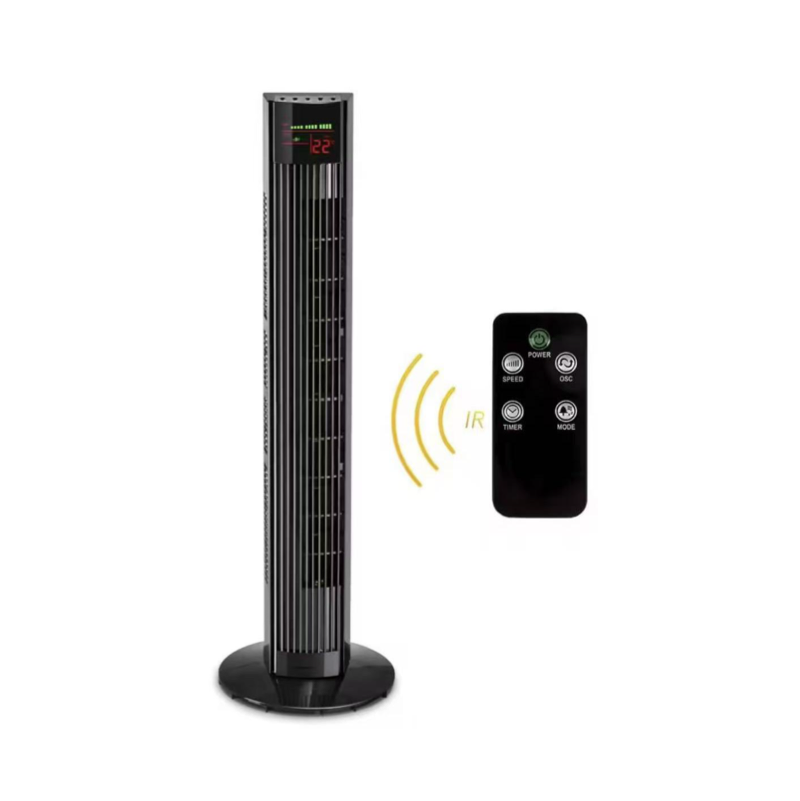
The physical height of a cooling unit directly impacts its air distribution capabilities, raw material consumption, and overall shipping volume. Procurement officers must carefully align the physical dimensions of the unit with the intended end-user environment.
Often overlooked, the 29-inch model is an incredibly strategic entry-level SKU. Drawing typically 50W of power and featuring a 90-degree oscillation sweep, these units are engineered for tight spaces like office cubicles or small dorms. Because the housing is shorter, material costs are rock bottom, and you can pack a massive amount of inventory into a single shipping container.
The 32-inch model represents the industry standard for modern residential spaces. From an engineering standpoint, this size perfectly balances motor torque with airflow delivery. A high-quality wholesale 32 inch tower fan typically features a reliable 50W motor, 3 distinct wind modes (Normal, Natural, Sleep), and a 15-hour programmable timer paired with a crisp LED display.
For distributors, this is your bread and butter. The compact retail box dimensions allow logistics teams to maximize the cubic meter (CBM) allowance of a 40HQ container, drastically lowering the landed freight cost per item.
When outfitting larger environments such as open-plan living rooms or master bedrooms, the 36-inch model becomes the preferred choice. The extended height allows the appliance to project a wider breeze over tall furniture. Retail customers psychologically associate taller appliances with enhanced power and luxury.
Consequently, sourcing a wholesale 36 inch tower fan requires a higher initial capital outlay. However, when equipped with premium features like an extended 15-hour timer, remote control functionality, and a sleek LED interface, it caters perfectly to a demographic willing to pay a premium for superior cooling coverage.
Specification | 29-Inch Compact | 32-Inch Standard | 36-Inch Premium |
|---|---|---|---|
Typical Motor Power | 50W (AC) | 50W (AC) / Optional DC | 50W - 60W (AC/DC) |
Ideal Application | Dorms, Desks, Small Rooms | Bedrooms, Apartments | Living Rooms, Large Offices |
Key Features | 90° Oscillation, Mechanical/Basic LED | 3 Modes, 15H Timer, Remote, LED Display | Wide Breeze, 15H Timer, Remote, Premium LED |
Container Efficiency (40HQ) | Highest (Lowest freight per unit) | High (Optimal balance) | Moderate (Higher freight per unit) |
When purchasing inventory by the container load, certain functional features transition from "optional upgrades" to absolute necessities. Overlooking these will severely damage your brand reputation.
First, stationary cooling is obsolete. Securing a bulk oscillating tower fan is non-negotiable for B2B buyers today. A standard motorized oscillation sweeps air across a 60 to 90-degree arc. During your sample testing phase, listen closely. The internal gearbox must operate smoothly without emitting clicking or grinding noises at the end of its rotation arc.
Acoustic engineering is equally paramount. Because these appliances sit mere feet from sleeping consumers, request accurate decibel (dB) ratings from the factory. An optimal bedroom unit should operate below the 50dB threshold on its lowest setting. Rattle or high-pitched stator whine will inevitably generate negative e-commerce reviews.
Finally, inspect the ease of assembly. Most units ship disassembled to save space. If a consumer opens a box to find complicated screws and poorly translated instructions, that frustration translates to a costly return. Prioritize models featuring tool-free assembly with simple interlocking plastic tabs and oversized thumb nuts.
The initial factory quotation—often listed as the FOB (Free On Board) price—is merely the starting line. To calculate a true ROI, you must factor in shipping logistics.
Ocean freight is dictated by volume (Cubic Meters or CBM). Because fans are relatively lightweight but bulky, they "cube out" a shipping container long before hitting weight limits. A 40-foot High Cube (40HQ) container holds roughly 68 CBM. Even a slight increase in retail packaging dimensions can reduce the total unit count by 10%, mathematically increasing your landed cost.
Custom packaging also eats into margins. White-labeling products with your brand logo adds immense retail value, but this OEM service isn't free. Custom-colored plastics and high-resolution boxes cost more than standard brown kraft packaging. If your inventory is destined for e-commerce, ensure the factory uses ISTA drop-test certified packaging to survive courier transit.
The operational success of a B2B transaction relies heavily on the supplier's integrity. For high-volume orders exceeding 1,000 units, dealing directly with the factory yields the most aggressive pricing. Direct relationships afford better control over OEM customizations and faster troubleshooting.
Never authorize a bulk purchase order based solely on polished digital catalogs. Import a physical production sample and test it ruthlessly. Physically tip the unit over to ensure the safety shut-off switch engages immediately. Check the front grilles to ensure toddlers cannot insert their fingers into the blower wheel.
In mass manufacturing, a zero percent defect rate is a myth. Professional buyers negotiate a "Free of Charge" (FOC) spare parts allowance. A standard agreement includes 1% to 2% of critical spare parts—such as extra PCBs or remote controls—shipped alongside the main order, empowering local retailers to handle minor repairs swiftly.
Successfully navigating the pricing landscape of cooling appliances requires balancing technical specifications with logistical realities. Distributors must weigh motor efficiency, oscillation angles, and physical dimensions against the constraints of shipping volumes and target demographic budgets.
We strongly recommend that procurement teams request physical samples to determine which form factor resonates best with their audience. By factoring in hidden freight costs, insisting on rigorous safety certifications, and partnering with verified manufacturers, buyers can confidently secure inventory that drives substantial business growth. Ready to upgrade your inventory? Explore a comprehensive range of engineered cooling solutions at FSWinsight to find the exact specifications that match your market demands.
Minimum Order Quantities typically range from 200 to 500 units for standard, off-the-shelf models. However, if your procurement strategy requires OEM services—such as custom brand logos molded into the plastic, specific Pantone color matching, or fully customized retail packaging—the factory will usually increase the MOQ to 1,000 units or more to justify the necessary production line adjustments and tooling costs.
Wholesale prices are heavily tethered to the global commodities market, specifically copper (used in motor windings) and petroleum-based resins like ABS and PP (used for the housing). When these raw material costs surge, factories adjust their FOB prices accordingly. Buyers should monitor these indices; sourcing during a dip in raw material costs can significantly improve your overall profit margins.
Yes, international shipping costs are heavily dictated by cargo volume rather than just weight. The extra four inches in height necessitates a longer retail box and larger protective Styrofoam inserts. This increased packaging dimension reduces the total number of units that can physically fit into a standard 40HQ shipping container, which marginally increases the freight cost assigned to each individual unit.
For standard models with minor OEM customizations (like logo printing and branded packaging), factories generally require a lead time of 30 to 45 days. However, if you are ordering during the peak pre-summer production rush (typically February through April), lead times can stretch to 60 days. Always factor in an additional 25 to 35 days for ocean transit depending on your destination port.
Not inherently. While the vast majority of mid-tier and premium units include infrared remote controls as a standard feature, ultra-budget models often rely exclusively on manual, top-mounted mechanical dials to keep manufacturing costs as low as possible. It is imperative that buyers explicitly specify the inclusion of remote controls when requesting initial factory quotes.
Certifications are strictly market-specific and legally required for retail distribution. For the North American market, you must ensure products carry valid UL or ETL testing certifications. For the European market, CE marking and RoHS compliance are absolutely mandatory. Australian importers must look for SAA approval. These certifications guarantee that the internal wiring, motor housing, and physical stability meet rigorous international fire and electrical safety standards.

