
Views: 0 Author: Site Editor Publish Time: 2026-06-09 Origin: Site


Standard commercial cooling often falls short in heavy-duty environments. Such inadequacies lead to rapid heat stress, dangerous equipment fatigue, and serious compliance risks. Choosing an industrial-grade cooling solution requires moving beyond basic retail specifications. You must evaluate equipment based on continuous-duty performance and strict safety compliance to ensure operational stability. We designed this guide to help facility managers and procurement teams build a highly objective framework. We will explore how to thoroughly evaluate fan specifications, manufacturing standards, and supplier capabilities. You will learn to identify reliable equipment. This careful selection process maintains worker safety, mitigates daily hazards, and enhances overall productivity.
Airflow vs. Application: Cubic Feet per Minute (CFM) must be matched to specific facility volume and heat density, not just taken at face value.
Motor Durability: Totally Enclosed Fan Cooled (TEFC) motors are critical for facilities with high dust or moisture levels.
Safety & Compliance: A reliable manufacturer must guarantee UL/cUL certifications and OSHA-compliant grill configurations.
Procurement Strategy: Evaluating a manufacturer goes beyond unit price; warranties, parts availability, and bulk fulfillment capabilities dictate long-term ROI.
Heat illness prevention remains a major focus for occupational safety regulators. Regulators issue strict guidelines to protect workers in high-temperature environments. Standard air conditioning often proves impractical in large manufacturing spaces. Targeted airflow offers a highly effective alternative. A properly deployed High Velocity Floor Fan accelerates sweat evaporation. This biological cooling process significantly lowers the perceived temperature for floor personnel. Comfortable workers maintain better focus. They make fewer errors and sustain higher productivity levels throughout their shifts.
Continuous air circulation also protects sensitive industrial equipment. Machinery generates massive amounts of thermal energy during continuous operation. Localized heat pooling often causes unexpected shutdowns. Directional airflow disperses these ambient hot pockets. It prevents machinery from reaching critical failure temperatures. Furthermore, continuous ventilation mitigates dangerous moisture buildup. Warehouses often struggle against condensation on concrete floors and metal fixtures. Constant air movement keeps surfaces dry. This process reduces slip hazards and prevents premature rust on expensive inventory.
You must establish clear success criteria before upgrading your cooling infrastructure. Vague goals lead to poor purchasing decisions. Facility managers should define specific baseline requirements for their cooling solutions.
Ambient Temperature Reduction Targets: Determine the exact temperature drop required in active work zones.
Acoustic Limitations: Set maximum decibel thresholds to prevent hearing damage and communication breakdowns.
Continuous Run-Time Capabilities: Specify how many uninterrupted hours the equipment must operate daily.
Understanding airflow metrics ensures you purchase the correct equipment size. Cubic Feet per Minute (CFM) measures the total volume of air moved. You must calculate true airflow requirements based on your specific facility dimensions. Multiply the room length, width, and ceiling height to find the total volume. Divide this number by your desired air exchange rate. This calculation reveals the exact CFM needed to refresh the space adequately.
Peak CFM claims often mislead buyers. Volume alone does not guarantee effective cooling. You must also evaluate air velocity. Velocity dictates the throw distance of the air stream. A fan might boast a massive CFM rating but fail to push air across a wide warehouse. Narrower blade pitches often create tighter, faster air columns. These focused streams penetrate deep into long aisles. Always balance total volume against necessary throw distance.
Motor topology directly influences longevity and power efficiency. Industrial environments present harsh conditions for electrical components. You must choose between Open Drip Proof (ODP) and Totally Enclosed Fan Cooled (TEFC) motors. ODP motors allow ambient air to flow through the casing. They work well in clean, indoor environments. However, they fail quickly when exposed to airborne debris. TEFC motors seal the internal components completely. An external blade blows air over the ribbed casing to cool the unit. They cost more initially but survive much longer in harsh conditions.
Motor Topology | Environment Suitability | Maintenance Needs | Lifespan Expectancy (Heavy Duty) |
|---|---|---|---|
Open Drip Proof (ODP) | Clean, dry, climate-controlled spaces | Requires frequent interior cleaning | Moderate |
Totally Enclosed Fan Cooled (TEFC) | Dusty, wet, or particulate-heavy areas | Minimal exterior wipe-downs | Maximum |
Drive mechanisms also impact your maintenance schedule. Direct drive models attach the blade directly to the motor shaft. This design minimizes moving parts. It reduces energy loss and requires almost no maintenance. Belt drive mechanisms use pulleys to spin the blades. They operate at lower speeds, which reduces noise. However, belts stretch over time. They require periodic tensioning and eventual replacement.
Acoustic footprints require careful consideration in industrial settings. Aggressive air velocity always generates noise. You must evaluate the trade-off between cooling power and acceptable decibel levels. OSHA mandates hearing protection for sustained noise above 85 decibels. Placing exceptionally loud fans near workstations creates compliance issues. Belt-driven models often provide high CFM with lower acoustic profiles. They serve well in areas requiring frequent verbal communication.
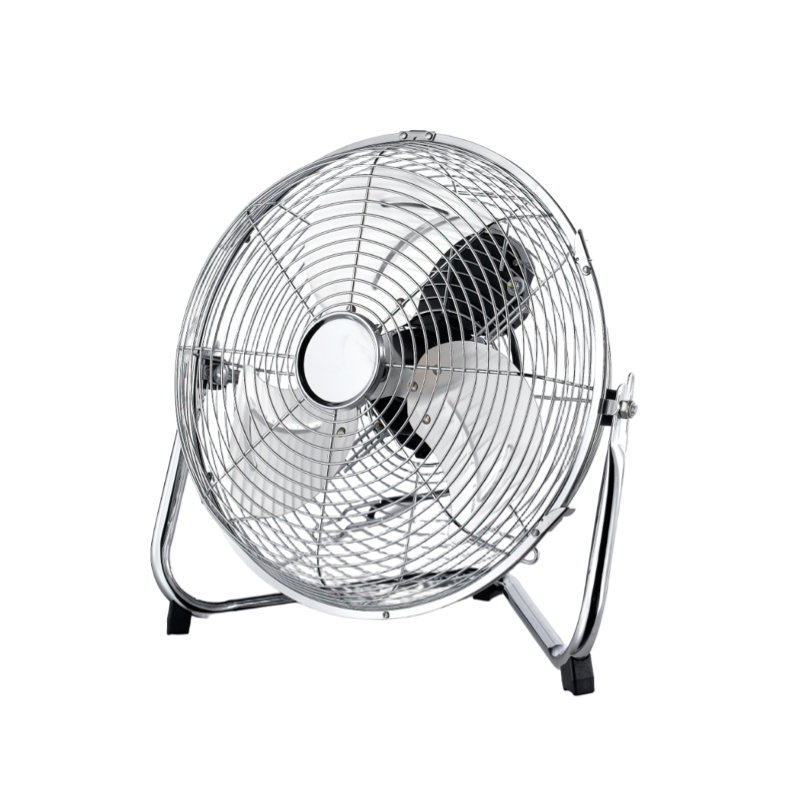
Material selection defines the structural integrity of industrial cooling equipment. Retail models often use lightweight plastics or thin metals. These materials crack under industrial abuse. You should seek out heavy-gauge steel housings. Steel resists impacts from forklifts and dropped tools. Some applications benefit from commercial-grade aluminum. Aluminum resists corrosion beautifully in humid environments. It also reduces the overall weight of mobile units.
Blade pitch design and balancing standards separate premium manufacturers from budget builders. Improperly balanced blades create microscopic vibrations. These vibrations travel through the motor shaft. They slowly destroy the internal bearings. A high-quality Floor Fan undergoes rigorous dynamic balancing at the factory. This process ensures smooth operation. It prevents long-term metal fatigue and catastrophic structural failure.
Mandatory safety certifications protect your facility from catastrophic liabilities. Never purchase uncertified electrical equipment. You must verify UL/cUL listings for electrical safety. These independent laboratories test products against extreme electrical loads. Their certification guarantees the internal wiring will not spontaneously ignite during continuous use.
Physical hazard protection is equally important. Industrial fans require finger-safe wire grill spacing. OSHA enforces strict regulations regarding fan guards. Any fan located within seven feet of the floor must have a guard with openings no larger than one-half inch. This precise spacing prevents accidental amputations. A reliable manufacturer integrates these compliance standards into their baseline designs.
Component lifespan relies heavily on bearing selection. Bearings support the spinning motor shaft. Budget units often utilize sleeve bearings. Sleeve bearings use porous metal soaked in oil. They require routine manual lubrication. They dry out quickly in hot environments. Premium industrial fans feature sealed ball bearings. These bearings contain factory-applied synthetic grease. Steel shields lock the grease inside and keep contaminants out. Sealed ball bearings easily outlast sleeve variants and eliminate weekly maintenance tasks.
Electrical load constraints often surprise facility managers during large deployments. High-capacity motors draw substantial amperage. You must calculate the exact amp draw across multiple units. Plugging too many fans into shared commercial circuits leads to tripped breakers. Tripped breakers halt production and reset computerized machinery. Always consult a facility electrician before deploying dozens of new units.
Voltage requirements vary based on motor capacity. Standard units operate on standard 115V single-phase power. You can plug them directly into standard wall outlets. However, massive industrial floor blowers often require 230V or 460V 3-phase power. Three-phase motors run smoother and consume less electricity over time. They do require specialized hardwiring. You must ensure your facility infrastructure supports these high-voltage requirements.
Choosing the right form factor involves balancing mobility against stability. Manufacturers offer several distinct designs to address specific facility layouts.
Drum Fans: These feature deep cylindrical housings. They generate powerful, narrow air streams ideal for loading docks.
Pedestal Hybrids: These elevate the fan head above floor-level obstacles. They distribute air effectively over machinery.
Low-Profile Blowers: These sit flat against the ground. They direct high-velocity air across wet floors to accelerate drying times.
Caster wheel durability dictates how easily staff can relocate mobile units. Industrial environments destroy cheap plastic wheels. Look for solid rubber or polyurethane casters with steel locking mechanisms. Stationary deployment requires a different approach. Fans placed permanently near vibrating machinery tend to migrate across smooth concrete. Anti-skid rubber feet prevent this hazardous movement. They anchor the equipment firmly in place.
Hazard mitigation extends to cord management. Thick power cords snake across warehouse floors and create severe trip hazards. You must route cords safely along walls or under protective floor channels. Washdown procedures also introduce electrical risks. Food processing plants and chemical facilities use high-pressure hoses to clean equipment. Standard fans will short-circuit under these conditions. You must source specialized washdown-rated units for these extreme environments.
Evaluating a manufacturer requires looking beyond the mechanical specifications. Supply chain reliability dictates how quickly you can upgrade your facility. Assess a manufacturer's capacity to fulfill high-volume orders. Lengthy lead times delay critical safety improvements. Summer heatwaves arrive predictably every year. You need a vendor who maintains deep domestic inventory. They must ship bulk orders without imposing multi-month delays.
Warranty structures reveal a manufacturer's confidence in their engineering. Read the fine print carefully. Differentiate between limited consumer warranties and comprehensive industrial coverage. Consumer warranties often void automatically if used in commercial settings. A strong industrial warranty specifically covers premature motor failure. It should not contain hidden clauses regarding daily run-time limits.
Aftermarket support prevents early unit retirement. Industrial equipment occasionally suffers damage despite robust construction. Forklifts back into grills. Debris strikes fan blades. You need immediate access to replacement parts. Verify domestic parts availability before signing a purchase order. A dependable vendor stocks replacement blades, heavy-duty switches, and spare motors. Repairing a premium Floor Fan costs significantly less than buying a completely new unit.
Executing a pilot program mitigates large-scale purchasing risks. Never commit to a facility-wide rollout based solely on a brochure. Request one or two test units from your shortlisted vendors. Deploy them in your harshest facility zones. Monitor their performance over several weeks. Gather direct feedback from floor workers regarding noise levels and cooling efficacy. This hands-on testing provides invaluable data for your final procurement decision.
Treating cooling equipment as disposable commodities harms facility budgets. You must view them as critical facility infrastructure. Upgrading to industrial-grade units eliminates constant replacement cycles. It protects workers from severe heat stress and keeps machinery operating within safe thermal limits. Evaluating both the mechanical specifications and the operational reliability of the manufacturer guarantees the highest return on investment. Do not settle for equipment lacking proper safety certifications or sealed motor components. Audit your current facility cooling gaps immediately. Document your exact airflow requirements and infrastructure constraints. Then, request comprehensive technical spec sheets from shortlisted manufacturers to begin your facility upgrade.
A: You calculate required CFM by determining the total volume of your space. Multiply the length, width, and ceiling height together. Divide this total volume by your desired air exchange rate in minutes. For example, a 10,000 cubic foot room requiring a 5-minute air exchange needs a 2,000 CFM fan.
A: Industrial models utilize Totally Enclosed Fan Cooled (TEFC) motors. They feature continuous duty-cycle ratings for 24/7 operation. Manufacturers build them with heavier gauge steel to resist impacts. Furthermore, they employ sealed ball bearings to eliminate manual lubrication routines required by standard commercial fans.
A: Yes, but this specific application requires a TEFC motor. Open Drip Proof (ODP) standard ventilated motors pull ambient air through their casing. They will suffer premature failure from particulate ingress. TEFC motors seal internal components and use external airflow for cooling.
A: Standard maintenance intervals include monthly grill and blade cleaning to prevent imbalance. You should also conduct annual cord inspections to identify exposed wiring. Notably, models equipped with sealed ball bearings require no manual lubrication, significantly reducing your total maintenance burden.

